
Published: Nov 2025
Dravet Syndrome UK’s (DSUK) biennial professional day conference welcomed over 150 healthcare professionals, including consultants, nurses, and researchers, to hear about recent advances in understanding, diagnosing, treating and managing Dravet syndrome.
Setting the scene: remarkable progress
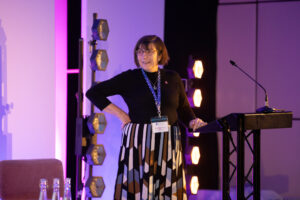
Prof. Helen Cross opened by highlighting the progress over the past 50 years: from gene association discovery in 2001 to disease-modifying therapies targeting that gene now in clinical trials; and from the first clinical description of the condition in 1978, through the updated ILAE definition in 2022, to the ongoing SCN1A Horizons Natural History Study which is describing Dravet syndrome in unprecedented detail. Prof. Cross noted how research into Dravet syndrome has catalysed broader interest in monogenic epilepsies and developmental and epileptic encephalopathies, with potential impact beyond the Dravet syndrome community.
Improving diagnosis across the lifespan
Prof. Andreas Brunklaus addressed the diagnostic odyssey patients face and how clinicians can make earlier, more confident diagnoses. He discussed the spectrum of SCN1A-related conditions and presented a prediction model that he co-developed using genetic results and age of seizure onset. Prof. Brunklaus emphasised that Dravet syndrome remains an electroclinical syndrome and that the absence of an SCN1A mutation may reflect mosaicism, test limitations, or SCN1A mimic involvement. He also shared findings from a recent study, which DSUK also collaborated on, about best practices for communicating a diagnosis of Dravet Syndrome: ensuring the diagnosing clinician will remain involved in care, offering prompt follow-up, connecting families with patient groups, and discussing SUDEP risk early.
Building on this theme, Prof. Sanjay Sisodiya highlighted the importance of diagnosing adults, noting that large numbers remain undiagnosed, limiting our understanding of adult presentation and SUDEP risk in this population. Genetic testing in adults enables access to appropriate medication, research participation, connection with support groups, and better advocacy for multidisciplinary and social care. Prof. Sisodiya advocated for retesting adults with idiopathic epilepsy and intellectual disability, particularly if previous testing is over five years old, given rapid improvements in test parameters.
Understanding presentation and progression
Dr Lisa Clayton explored adult-specific challenges and the extensive comorbidities affecting adults living with Dravet syndrome. With seven times more studies focusing on children than adults, substantial knowledge gaps remain about comorbidity progression. Dr Clayton described motor, psychiatric and feeding issues, emphasising the need to understand potential skill loss with ageing to determine if this is preventable or treatable. She called for pathological data and further research, noting that adults today, who are exposed to more sodium channel blockers, may present differently to future adults who benefit from improved management.
Dr Amy McTague, Dr Stewart Rust and Adriana Swindler presented initial data from the SCN1A Horizons Natural History Study. Dr McTague outlined the project’s aim to improve standards of care, whilst Dr Rust and Adriana Swindler discussed the neuropsychology testing battery and approaches to meaningfully assess changes in development. Dr Rust highlighted the study’s process of providing research feedback reports to clinicians and participants, a rare initiative benefiting those taking part with impact beyond the study itself.

Supporting families: clinical care and research priorities
Neil Williamson, DSUK trustee and former epilepsy nurse, explained the vital role of epilepsy nurses in holistic care throughout the lifetime. He shared insights from supporting families, particularly the skill of informing without overwhelming, and discussed caregiver impact and the ‘never-ending war of loss’, sibling effects, and the evolving balance between safety and freedom as individuals with Dravet syndrome age.
Ceri, DSUK’s Chief Scientific Officer, then outlined DSUK’s research focus on under-researched areas: non-seizure aspects, adults, and family impact. She announced a new priority-setting project launched over the conference to gather families’ views on questions they want DSUK-funded research to address, and how research can be made more meaningful and accessible.
DSUK research in progress
Drs Lisa Clayton and Jenna Carpenter provided updates on their DSUK co-funded fellowships. Dr Clayton outlined her investigation of autonomic dysfunction in adults with Dravet syndrome, explaining the process of examining body temperature dysregulation and cardiac autonomic control in 30 adults to identify presence, risk factors and links to other condition aspects. Dr Carpenter presented her genome engineering work addresses the genetic cause of the disorder, aiming to develop a one-time, long-lasting treatment targeting all aspects of the condition whilst mimicking healthy neuron function. She shared proof-of-concept studies with further results anticipated.
Current and future treatments
Prof. Sameer Zuberi provided an updated anti-seizure treatment overview, including comparative data on the three licensed treatments, current treatment algorithms, and medication interactions—particularly important given high polytherapy use in Dravet syndrome. Prof. Zuberi discussed two ongoing clinical trials for new anti-seizure medications and advances in rescue medications.
The day concluded with updates on disease-modifying therapies for Dravet syndrome from Dr Archana Desurkar and Profs Helen Cross and Andreas Brunklaus. Dr Desurkar explained what ‘disease-modifying’ means and its potential impact, noting the shared desire from patients and clinicians for treatments targeting all aspects of Dravet syndrome. Prof. Cross outlined a phase I/II clinical trial of an AAV9 vector, explaining its mechanism of action, administration method and trial design, with results expected soon. Prof. Brunklaus shared promising results from an ASO in clinical trial, explaining how the treatment works and the administration procedure. He presented data from the three-year open-label extension study showing sustained reductions in seizure frequency, alongside improvements in cognition and behaviour. Phase III recruitment for this treatment will begin soon.

The conference showcased both the significant progress made in understanding and treating Dravet syndrome and the community’s continued commitment to addressing knowledge gaps, ensuring advances benefit everyone living with Dravet syndrome.