
Research Achievements
Find out more about the research achievements we’ve made so far.
Find out more about how you can take part in studies to improve understanding of Dravet Syndrome and, if you're a researcher, discover what support we can provide.
By taking part in our research, you’ll help to improve understanding of Dravet Syndrome and find more therapies to benefit everyone affected by the condition.
Taking part can be anything from talking about your experience in a focus group, answering survey questions about living with Dravet Syndrome, or trialling new devices.
Current opportunities on this page (click on the project to read more):
For any questions about opportunities on this page, please contact [email protected]
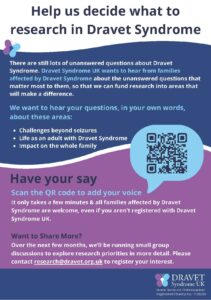
We are asking families to share the unanswered questions that matter most to them; we want to hear families’ questions, in their own words, about these areas:
Share the questions that matter most to your family.
Over the next few months, Dravet Syndrome UK will also be running small group discussions to explore research priorities in more detail. If you’re interested in taking part, please register here or contact us at [email protected]
Prof. Sameer Zuberi is looking at whether a small biosensor attached to the chest can detect breathing patterns, including stopping breathing, during and after seizures. You can read more about this study here.
As part of this project, the device will be trailed on children living with Dravet Syndrome. Prof. Zuberi’s team would like to speak to a small group of parents of children living with Dravet Syndrome in an online workshop about the study design. There will be reimbursement for involvement. If you are interested in joining this workshop, please email [email protected].
The SCN1A Horizons Natural History Study aims to map how Dravet Syndrome presents and changes across the lifespan by following individuals over time. The study is recruiting participants across the UK and is open anyone with a confirmed SCN1A-related epilepsy. The study currently includes around 150 patients and is looking to increase representation within the 0-2 years and 17+ years age bracket.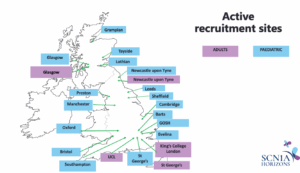
If you would like to participate, please contact the study team on [email protected] (including the name of your neurologist and hospital).
Find out more about the research achievements we’ve made so far.
Discover current developments in Dravet Syndrome research.