

Emergency medication and treatment
Find out what treatment someone with Dravet Syndrome may need in an emergency.
Children and adults living with Dravet Syndrome normally need a combination of tailored anti-seizure medications.
These help to control or reduce their seizures. Keeping someone free from seizures is the ultimate goal of these medications, however, good seizure control in Dravet Syndrome is rare.
The following medications may be used to treat the condition and aim to control or minimise seizures. Not all of them are suitable for everyone with Dravet Syndrome.
In 2022, international experts put together a ‘treatment algorithm’ based on their experience of the most effective order to trial medications in people living with Dravet Syndrome.
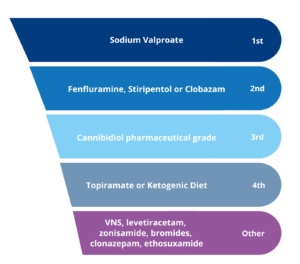
Graphic adapted from Wirrell et al, Epilepsia (2022)
In children, some medications can increase or prolong someone’s seizures if they have Dravet Syndrome. If they are used for a long time, these drugs can affect intellectual development. These medicines are called ‘sodium channel blockers’. They include:
In adults, sodium channel blockers should only be used to treat Dravet Syndrome when they are carefully monitored by medical professionals. They might be prescribed if a young person or adult receives a new diagnosis.
Overall, there is not enough evidence of the effect that sodium channel blockers have on adults because there haven’t been enough randomised controlled trials that have included them.
In the UK, the NHS recommends that people with any type of epilepsy, including Dravet Syndrome, continue to get the same version of their epilepsy medicine, wherever possible, as seizure control is particularly sensitive to changes in medication.
If a doctor decides that a patient should stay on a specific brand name, this should be written on the prescription, and pharmacists have to provide that brand. If the prescribed product is unavailable, it may be necessary to give a product from a different manufacturer to maintain continuity of treatment but this should be discussed and agreed with both the doctor and family. For most people, it’s safer to take a different version of their medicine than to stop taking it.
When thinking about the impact of switching brands, medications are split into 3 categories:
There are a number of guidelines, statements and publications outlining treatment for Dravet Syndrome. These are:
Find out what treatment someone with Dravet Syndrome may need in an emergency.

Read about the three treatment plans that families affected by Dravet Syndrome need to create with their medical team.