
About Dravet Syndrome
Dravet Syndrome is a rare, life-long and life limiting neurological condition. It includes seizures, intellectual disability and a range of associated health conditions known as ‘comorbidities’.
Disease‑modifying therapies target the underlying SCN1A deficit rather than just treating seizures. Over the last few years, there has been important progress in the potential treatments for Dravet Syndrome.
Traditionally, treatments for Dravet Syndrome have been directed at control of seizures, mainly through anti-seizure medications, but also through specialist dietary treatments, mainly the ketogenic diet and less often with neurostimulation such as vagal nerve stimulation. Most people living with Dravet Syndrome remain on a number of medications but rarely reach seizure freedom. Moreover, they continue to face significant challenges with learning, feeding, sleep, behaviour and sometimes gait. They are also at high risk of SUDEP. This is because anti‑seizure interventions treat the symptoms of Dravet Syndrome, not its underlying cause.
Just 20 years after Dravet Syndrome was linked with changes in the SCN1A gene in 2001, the first treatment aiming to target SCN1A deficiency entered clinical trials in humans. These so‑called “disease‑modifying treatments” are designed to target the root cause of the condition, rather than managing seizures alone.
SCN1A is a gene that contains the instructions for making Nav1.1 channels, which are proteins that brain cells need to communicate properly. In Dravet Syndrome, one of the two copies of SCN1A has an error, meaning it produces incomplete or unusable instructions; as a result, brain cells have roughly half the number of working Nav1.1 channels they need.
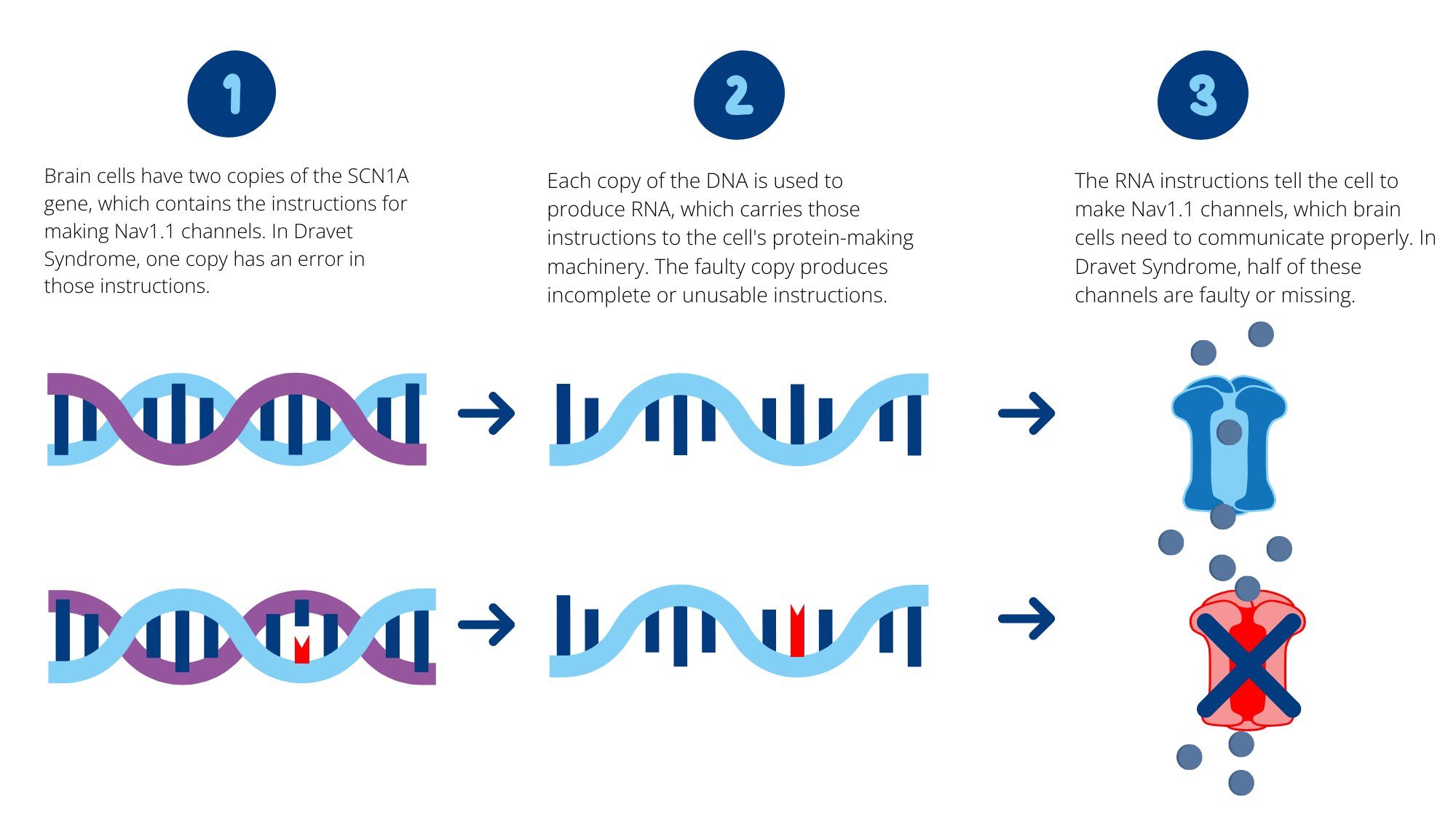
Disease‑modifying therapies aim to correct or compensate for this at different points in that process. In theory, a therapy that targets the underlying cause has the potential to improve not just seizures, but many aspects of the condition.
We are now at an exciting point in the research landscape, with three ongoing clinical trials of disease‑modifying therapies in Dravet Syndrome and many more being developed and tested in laboratories.
The aim of disease‑modifying therapies in Dravet Syndrome is to improve how brain cells work by increasing the amount of functioning Nav1.1 protein.
By targeting this underlying mechanism, the aim is to improve not only seizures but also wider aspects of the condition including learning and behaviour.
However, while these treatments may improve several aspects of Dravet Syndrome, they are unlikely to be able to completely modify all the additional co-morbidities and risks.
Early trial data suggest promising reductions in seizure frequency and signs of benefit in some cognitive areas. In the studies reported so far, these changes have tended to build gradually over months and to continue evolving over a year or more, rather than happening all at once.
At the same time, it is important to be realistic about what these treatments are unlikely to do. Symptoms of Dravet Syndrome typically begin before diagnosis, meaning that, by the time treatment could start, the brain has already spent some time developing under the influence of seizures and SCN1A dysfunction. There is also emerging evidence that SCN1A plays a role before birth, which suggests that treatment started after birth may not address every aspect of the condition.
SCN1A also appears to play a role in the heart, and Dravet Syndrome carries a higher than average risk of sudden unexpected death in epilepsy (SUDEP). Because the disease‑modifying therapies currently in trials are designed to act mainly in the brain, we do not yet know how much they will change this risk. It will remain important to continue the usual strategies for reducing SUDEP risk, even if seizures and development improve.
Taken together, it is unlikely that these treatments will “cure” Dravet Syndrome in the sense of removing the condition entirely. Initial data show real promise in improving symptoms and quality of life, but it is sensible to assume that people receiving disease‑modifying treatments will still live with some degree of disability and will still need ongoing support, medical care and risk‑reduction strategies. Overall, the realistic goal is to slow or stabilise progression and create better conditions for future brain development. The extent of the benefits and limitations of disease-modifying therapies will only become clear after several years of research.
Developing a disease‑modifying therapy is not straightforward. This is a relatively new research area, so there is still a lot to learn about how disease‑modifying therapies can be made to work better for more people. Understanding the challenges involved helps explain why development takes time, why there are multiple approaches being explored, and why careful testing is so important.
For any disease-modifying therapy to work in Dravet Syndrome, some of the key considerations are:
There is no single approach to developing a disease-modifying therapy for Dravet Syndrome. Because of the challenges described above, researchers have developed several distinct strategies, each working in a different way or intervening at different points in the journey from DNA to protein. Understanding what each approach does, and how it is given, helps make sense of why so many different therapies are in development at the same time.
Approaches in late-stage studies
Late-stage studies are those in clinical trials and being tested in humans.
Antisense oligonucleotides (ASOs)
ASOs work at the RNA stage, the step between DNA and protein. In healthy conditions and in Dravet Syndrome, some of the RNA instructions produced from the working copy of SCN1A are discarded before they can be used to make protein. ASOs are short molecules that temporarily attach to the cell’s RNA and adjust how it is processed with the goal of increasing the amount of functional protein the cell produces.
Because ASOs do not become a permanent part of the cell, they are gradually broken down and cleared by the body. This is why they need to be given repeatedly, typically every few months, via an injection into the spinal fluid.
Gene regulation therapies
These therapies act at the DNA level by helping the working copy of a gene to be “read” more often, so that cells produce more of the corresponding RNA and, in turn, more of the protein that gene encodes.
In current approaches for Dravet Syndrome, new genetic instructions are packaged inside a modified virus called an AAV vector, which is used purely as a delivery vehicle to carry these instructions into brain cells. The virus has been stripped of its own genetic material, leaving an “empty shell” used to carry the therapeutic instructions.
Once inside, these instructions do not alter the cell’s own DNA, but they sit in the cell as a separate unit that is read alongside the cell’s own DNA. Because brain cells do not divide, this treatment is expected to persist for many years, which is why this approach is designed as a one‑time treatment, generally given as a single infusion directly into the fluid in the brain.
Approaches in earlier development
Several other strategies are being explored in laboratories, targeting different points in the process of building Nav1.1. These are called early-stage studies and often use cell and animal models:
All of these approaches are showing early promise in cell and animal studies, but none have yet entered clinical trials in humans.
We asked Dr Thomas Roberts why preclinical work on ASOs is continuing, even as the first ASO moves through late‑stage trials? What are researchers hoping newer ASOs might add or improve on?
Dr Roberts said: “The progress of the first SCN1A-targeting antisense oligonucleotide (ASO) into late-stage clinical trials is an exciting milestone for the Dravet syndrome community and reflects many years of research. While the results so far are encouraging, drug development is challenging, and it is important to continue exploring additional approaches. Even if a treatment is successful, there is no guarantee that it will be suitable for everyone, so building a pipeline of new therapies remains essential.
Our research explored a completely different way of increasing SCN1A protein by targeting the natural mechanisms that regulate how much protein is made, rather than the approach used by the current clinical ASO. Although this particular strategy was not as effective as we had hoped, the work has improved our understanding of how SCN1A is regulated. This fundamental knowledge is valuable because it helps researchers identify which approaches are less likely to succeed and which new strategies may hold more promise.
Importantly, different ways of increasing SCN1A are not necessarily competing approaches. Therapies that work through different biological mechanisms could one day complement each other or inspire improved treatments. Continuing preclinical research is therefore essential to expand the range of options and ultimately develop safer and more effective therapies for people living with Dravet Syndrome.”
 Dr Thomas Roberts is an associate professor at the University of Oxford, where he leads work on RNA medicines, including antisense oligonucleotides (ASOs) and other gene-targeting approaches. He co-led a Dravet Syndrome UK and Great Ormond Street Hospital–funded project exploring whether ASOs could increase SCN1A protein. You can find out more about this research here.
We asked Dr Jenna Carpenter why it’s important to keep exploring new kinds of disease‑modifying therapy for Dravet Syndrome, even if current ASO and AAV‑based treatments show encouraging early results?
Dr Carpenter said: “Encouraging results from clinical trials of ASO- and AAV-based treatments do not remove the need to develop new approaches. These therapies test the same central idea – whether increasing SCN1A expression from the remaining working copy of the gene is safe and can change the course of Dravet Syndrome. They also provide information on how well different treatment methods are tolerated. Evidence from trials can therefore guide the development of new therapies, such as gene editing, where strong evidence is needed because these therapies make permanent changes to DNA.
Every therapy involves trade-offs and may suit different patients and families. ASO treatments can be discontinued but require repeated dosing, whereas AAV-based therapies may provide longer-lasting effects, but are harder to reverse and re-dose. New therapies aim to reduce these trade-offs and potentially address more of the developmental and cognitive aspects of Dravet syndrome as well as seizures. Gene editing has the potential of a one-time, durable treatment by editing the SCN1A gene at its natural location in the DNA. This may keep more of the cell’s natural control over where, when and how much SCN1A is produced. Furthermore, editing tools can be present for a short amount of time, potentially reducing immune responses and providing long-lasting therapeutic benefit.”
When thinking about early‑stage research, what early signs in cells or animal models would tell you that an idea is strong enough to move forward towards a clinical trial? What do you hope approaches like those in your own work might eventually add?
“In early-stage research, we are looking for increased SCN1A and Nav1.1 in human neurons, correction of disease-related changes in cells, and no excessive expression or unintended editing of genes other than SCN1A. Dravet Syndrome mouse models would then be used to assess how well the therapy can reduce seizures and improve survival, learning and behaviour. These results would be supported by strong data on safety, tolerability and delivery to the right cells and brain regions and would demonstrate a durable effect. Together, these results would provide the confidence needed to advance a promising new therapy towards clinical trials.”
 Dr Jenna Carpenter is a Dravet Syndrome UK and Epilepsy Research Institute Fellow and a senior research fellow at UCL. She is currently working on advancing precision medicine: genome engineering for on-demand gene therapy in Dravet Syndrome. You can find out more about her research here.
There are three ongoing clinical trials of disease‑modifying therapies for Dravet Syndrome. Early data are encouraging, but trials are still underway and we do not yet know the full benefits or risks. This information is correct up to 18/06/2026. Our “current clinical trials” webpage is kept up to date with UK‑based clinical trials for Dravet Syndrome and should be checked for the latest details
Zorevunersen: Phase 3
Zorevunersen, an ASO, is now in Phase 3 clinical trials. Safety data from Phase 1/2 studies, including up to five years of follow‑up for 81 treated patients, suggest that zorevunersen is generally well tolerated. The most common side effect has been an increase in protein levels in the cerebrospinal fluid. This has not been associated with symptoms and is a recognised effect of ASOs generally. There was one serious and persisting unexplained neurological event documented.
Initial signs of effectiveness are encouraging: reductions in seizure frequency of between 59% and 91% have been reported in early participants, alongside improvements across several cognitive domains.
ETX101: Pivotal Phase 1/2
ETX101, an AAV-based therapy, has moved into a pivotal Phase 1/2 study, aiming to collect safety and early effectiveness data in a larger group of children. Initial data indicate a favourable safety profile so far, with the best results seen at higher doses. The most commonly reported treatment‑related side effect has been temporary, asymptomatic changes in liver function tests, which have resolved in all participants reported so far.
ION337: entering Phase 1/2
ION337 is an ASO that works in a similar way to zorevunersen but is designed to remain active in the body for longer, which may allow for less frequent dosing. It has recently entered Phase 1/2 dosing trials. Over time, results from ION337 will help show whether differences in design translate into meaningful differences in outcomes or side‑effect profiles for families.
Age ranges and who can take part
One significant gap in the current trial landscape is the absence of adults. Ongoing trials focus on children and adolescents, meaning adults living with Dravet Syndrome cannot currently access them. Whether disease‑modifying therapies will be effective in adults whose brains have developed over many years of living with the condition remains an important and largely unanswered question.
The age ranges studied in clinical trials can have an impact on the later availability of new treatments via the NHS (if trials are deemed successful). This is because NHS availability is typically tied to the age ranges studied in clinical trials. We understand this can leave adults and their families feeling overlooked, and Dravet Syndrome UK is committed to highlighting their needs and pushing for research and access options that include them as evidence grows.
Deciding whether to take part in a disease‑modifying therapy trial is a major decision. Families may feel excitement, hope and pressure all at once, especially when a trial is framed as a rare opportunity or when others appear to be moving quickly. It is important to know that it is okay to take time and that there is no single “right” choice.
It can be helpful to think of the decision in two parts: “Is this trial scientifically suitable for my child?” and “Is this the right moment for our family, given everything else in our lives right now?”. Your neurology team can support you in exploring both aspects.
Some of the key points to weigh up include:
It can take time to gather enough information to know whether a treatment is safe and effective, and longer to decide if it will become more widely available. Given the current pipeline, if trials are successful, wider access may happen over the coming years.
We are at the beginning of a new chapter for Dravet Syndrome. SCN1A, first linked to this condition just over two decades ago, is now the target of multiple therapies, several of which are in clinical trials. This is an exciting time, and Dravet Syndrome UK is optimistic about where this field may lead. For the first time, we have clinical evidence that targeting the root cause of Dravet Syndrome may produce not just reductions in seizures, but improvements in cognition, behaviour and development.
At the same time, trials are still ongoing, and more data are needed to fully understand the benefits and risks of these treatments. There are important questions that current trials will not fully answer, including long‑term durability, the extent of benefit at different ages, and the impact on mortality risks. We also need to understand how these therapies sit alongside existing treatments and what they will mean for everyday life over many years.
There is still much to learn and much to do, but the field is making progress. Dravet Syndrome UK will continue to provide clear, independent information for the community, and work with developers, clinicians, and regulators to share the patient voice at all stages so that emerging treatments are developed and assessed in ways that benefit as many people as possible.
The most important first step is to speak to your neurology team. Useful questions to ask include:
Many families worry that, if they do not join an early trial, they will lose their only opportunity to access disease‑modifying therapies. While earlier intervention is thought to improve outcomes, it is also believed that people may benefit from these treatments at any age, even if the pattern and extent of benefit differ.
If the wider evidence continues to be positive, it is possible that these treatments will become more widely available, with stronger safety records, over the next several years. Your child may be able to access them at that point, either as part of later‑phase trials or, in time, through the NHS if approval and access decisions have been made.
Where treatments target different mechanisms and are not designed to be one‑off, there may be some potential for moving between them in future, although this is still being studied and depends on the details of each trial.
ASOs do not remain in the body permanently and require repeated dosing, which means that, in theory, someone could stop one ASO and later start another. However, ASOs can remain active in the brain for many months or longer, so careful planning of timing would be needed to allow one treatment to clear before another begins. In principle, taking part in an ASO trial should not automatically prevent access to a different ASO in future, but this will only become clearer as more is understood about how these treatments are cleared from the body, and how regulators choose to view switches between them.
Where a treatment is intended to be one‑off and long‑lasting, moving to a different one‑off disease‑modifying therapy afterwards may be more difficult. This is partly because the first treatment’s effect does not wear off, and partly because the body’s immune response to the viral delivery vehicle used in gene therapies may prevent a second dose of a similar treatment from working.
For any specific trial, eligibility for future studies will depend on the individual protocol and on decisions by regulators, so your neurology team will be the best source of advice for your child’s situation.
For now, yes. In all current trials of disease‑modifying therapies, children and young people continue their usual anti‑seizure medicines alongside the study treatment, and any changes to those medicines are made slowly and carefully by their neurology team. Even if a disease-modifying treatment is approved in the future, it is likely to be added to existing care at first rather than replacing all other medicines.
Over time, if a child’s seizures improve, their team may be able to reduce some medicines, but this will be an individual decision and may not be possible or appropriate for everyone. Families should expect that anti‑seizure medicines and other supports will still play an important role in care, even with a disease‑modifying therapy.
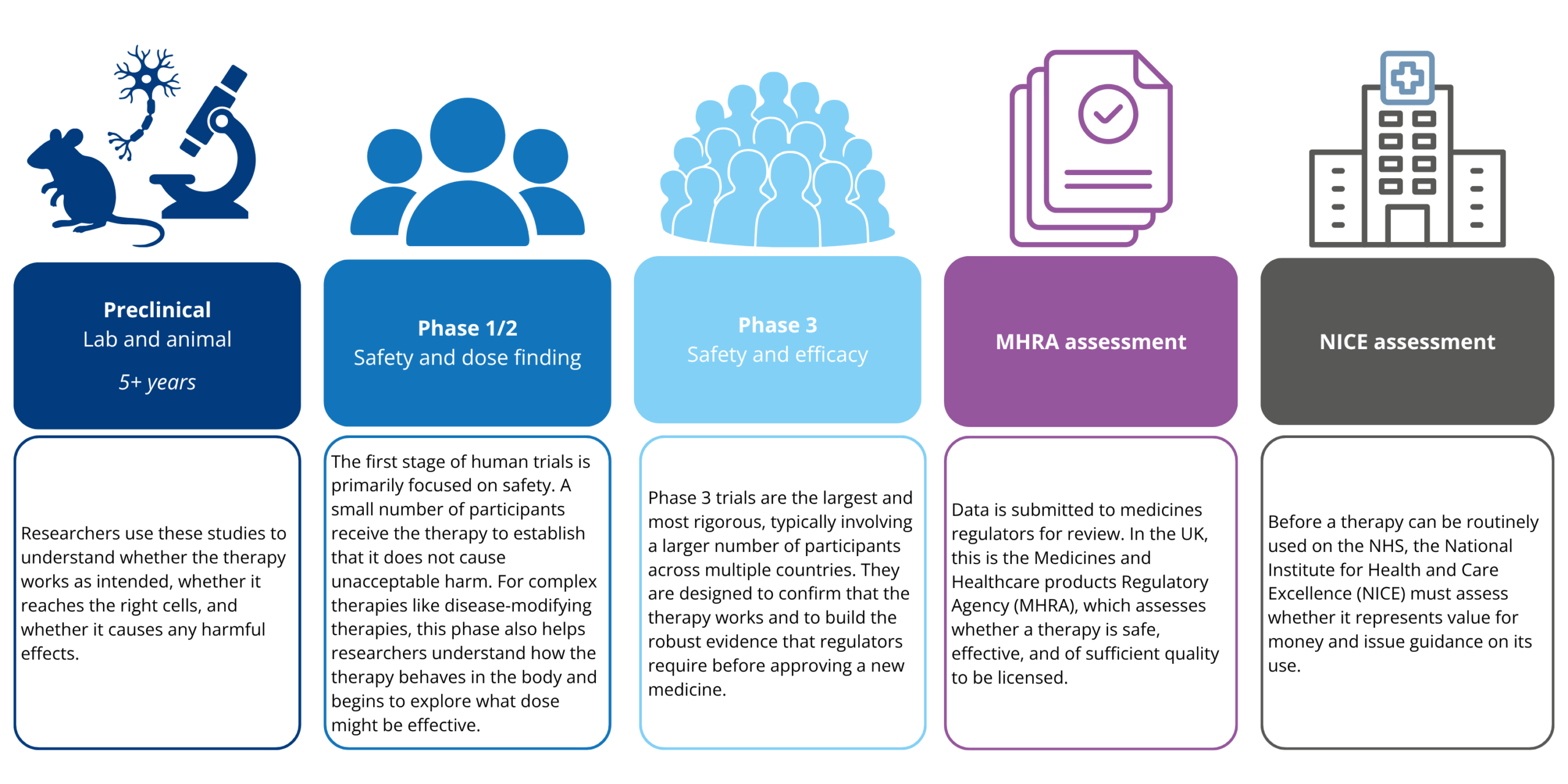
Before any therapy can become available on the NHS, it must pass through a series of carefully regulated stages, from laboratory research through to clinical trials, regulatory approval and, finally, assessment by NICE. This process is designed to ensure that treatments are safe and effective before they reach patients, but it does take time.
If Phase 3 results are positive, companies can apply to the Medicines and Healthcare products Regulatory Agency (MHRA) for a licence and then work with the National Institute for Health and Care Excellence (NICE) and the NHS on whether, and how, the treatment will be funded and offered in routine care. This process typically takes many months and sometimes longer.
The MHRA’s Rare Disease Therapies Framework may help shorten that journey in some cases, especially for conditions like Dravet Syndrome where the need is significant and there are limited alternatives. DSUK will be closely involved in ensuring the Dravet Syndrome community’s voice is heard throughout this process.
Dravet Syndrome is a rare, life-long and life limiting neurological condition. It includes seizures, intellectual disability and a range of associated health conditions known as ‘comorbidities’.

Here you can find useful information and get practical support in navigating the day to day challenges of living with Dravet Syndrome.
By becoming a Friend of Dravet Syndrome UK, your regular gift can turn uncertainty into dependable support that enables us to reach families when they need us most.