
Research Findings
Find out more about findings in Dravet Syndrome research.
Find out more about how you can take part in studies to improve understanding of Dravet Syndrome and, if you're a researcher, discover what support we can provide.
By taking part in our research, you’ll help to improve understanding of Dravet Syndrome and find more therapies to benefit everyone affected by the condition.
Taking part can be anything from talking about your experience in a focus group, answering survey questions about living with Dravet Syndrome, or trialling new devices.
Current opportunities on this page (click on the project to read more):
For any questions about opportunities on this page, please contact [email protected]
You are invited to complete the survey below as it will enable us to enhance the design of clinical trials for new treatments for people with epilepsy.
https://redcapsurveys.uhbw.nhs.uk/surveys/?s=MCCY4YCCLE34MML9
We would like to learn what matters most to people living with epilepsy when taking part in epilepsy research for new treatments. Researchers often look at things like reductions in seizure numbers, but we know there’s much more to life with epilepsy for example better mood, fewer hospital visits or improved quality of life.
We have designed a survey to look into what matters most to you when trying a new treatment.
You can take part if you are:
• An adult living with epilepsy, or
• A parent, carer, or family member of a child or adult with epilepsy
The survey takes about 10 – 15 minutes. Your answers are anonymous.
If you have any questions regarding this survey, please do not hesitate to get in touch. You are under no obligation to take part, but if you do, your answers will help us to plan better studies and choose outcomes that are truly meaningful for people with epilepsy and their families.
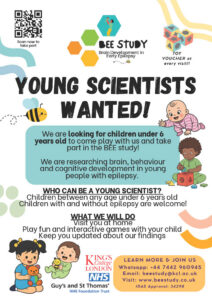
The Brain Development in Early Epilepsy (BEE) study is tracking children under 6 years old with and without epilepsy to investigate how brain and behaviour develop in childhood.
You can read more about the study at https://beestudy.co.uk.
As part of this study, children undergo home-friendly electrical brain activity monitoring
(EEG), eye tracking, and standard assessments to measure behaviours relating to autism,
ADHD, language disorder, and intellectual disability. The study is open to any child under 6
years old with a diagnosis of infantile spasms and/or focal seizures in the first year of life. If a child has a possible diagnosis or a pending diagnosis, they may also take part.
If your child is eligible and you are interested in taking part, please
email [email protected] or call +44 (0)7442960945.
If you have any questions regarding this survey, please do not hesitate to get in touch. You are under no obligation to take part, but if you do, your answers will help us to plan better for impacts due to climate change.
The SCN1A Horizons Natural History Study aims to map how Dravet Syndrome presents and changes across the lifespan by following individuals over time. The study is recruiting participants across the UK and is open anyone with a confirmed SCN1A-related epilepsy. The study currently includes around 150 patients and is looking to increase representation within the 0-2 years and 17+ years age bracket.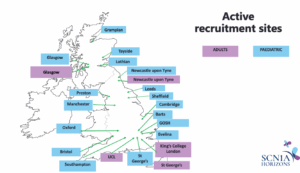
If you would like to participate, please contact the study team on [email protected] (including the name of your neurologist and hospital).
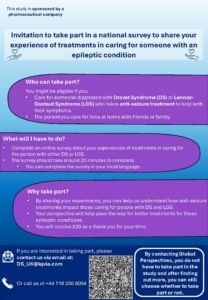
Click here to email IQVIA to express your interest
King’s College London and Kentown Support are researching how how social care support for children with life-limiting conditions and their families can be improved.
The study has three parts including interviews, focus groups with professionals, and working groups.
The aim of this research is to understand families’ and professionals’ priorities and recommendations for improving social care for children with life-limiting conditions.
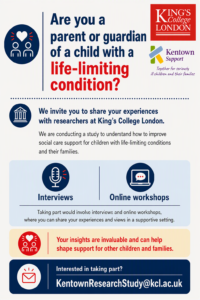
If you are interested in taking part, please email [email protected]
Find out more about findings in Dravet Syndrome research.
Discover current developments in Dravet Syndrome research.